Adobe Commerce pricing is quote-based. Adobe doesn't publish a standard US dollar subscription for its Commerce as a Cloud Service, Commerce on Cloud or Commerce Optimizer options on the current pricing page. The cost depends on the product architecture and commercial agreement, so you'll need a written quote rather than a third-party starting-price estimate. Never rely on a number you can't trace to Adobe.
The most important first decision is what the business wants Adobe to run. A full SaaS commerce service, a dedicated PaaS environment and a storefront or merchandising layer for an existing transaction engine aren't interchangeable purchases. A quote for one shouldn't be compared directly with another without mapping the included responsibilities.
How much does Adobe Commerce cost?
Adobe Commerce costs are available through a customized sales quote rather than a public US price list. Adobe's official pricing page presents three distinct commercial options and invites buyers to request pricing. It doesn't establish a universal monthly fee, implementation budget or fixed GMV multiplier that can be safely applied to every merchant.
A useful procurement request should clearly specify the expected store architecture, transaction and catalog requirements, regions, integration scope and support needs. Always ask Adobe to itemize the subscription or license, hosting responsibility, optional services, support and any usage or volume assumptions. A quote that combines software and implementation into one number is hard to compare with a competing platform.
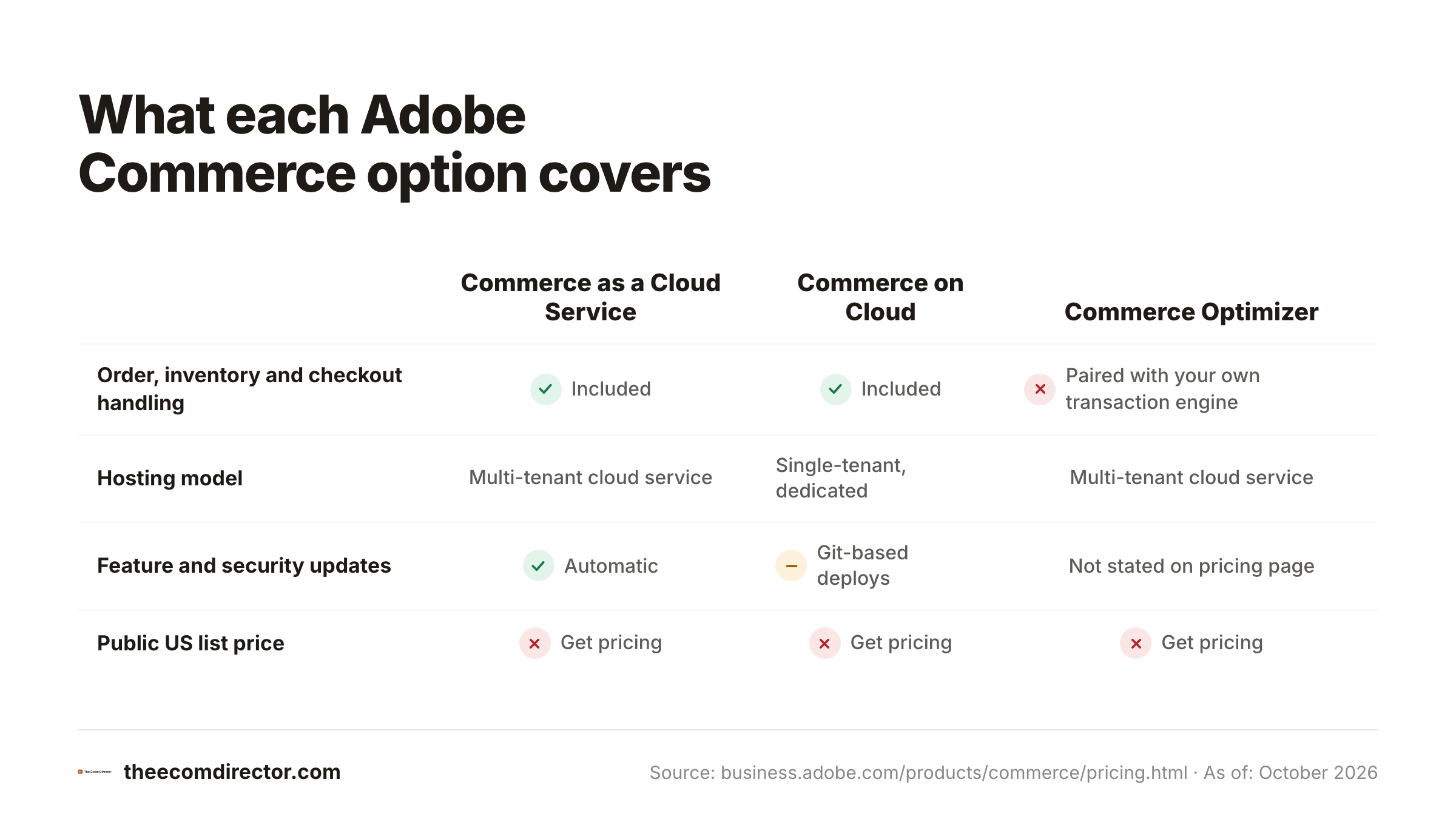
- Adobe Commerce as a Cloud ServiceCustom quote SaaS; contact Adobe
- Multi-tenant managed commerce service
- Automatic feature and security updates
- Full transactional commerce functions
- Adobe Commerce on CloudCustom quote PaaS; contact Adobe
- Dedicated single-tenant cloud infrastructure
- Merchant-controlled application deployments
- Git-based build and deployment workflow
- Adobe Commerce OptimizerCustom quote Storefront and merchandising layer
- Works with an existing transaction engine
- Catalog, search and merchandising services
- Not a replacement for the underlying checkout and order system
Official Adobe pricing page checked October 29, 2026. Adobe doesn't publish a universal USD rate for these options. Request a written quote for the chosen architecture.
What is included in Adobe Commerce as a Cloud Service?
Adobe Commerce as a Cloud Service is Adobe's multi-tenant SaaS option for running transactional ecommerce. Adobe describes automatic feature and security updates and a complete commerce solution. The architecture changes the work a merchant's engineering team owns. Instead of maintaining the same dedicated application environment as a PaaS deployment, the team configures and extends a managed service within the product's supported boundaries.
The buyer should still ask who owns product data, integration failures, payment configuration and business-specific checkout requirements. SaaS doesn't mean every workflow's automatic. For example, a catalog import can fail because an upstream ERP sends invalid data even if Adobe manages the platform infrastructure. A team should document the system of record and error-handling path before it assumes a managed service eliminates operational responsibility.
The quote should identify included environments, regions, support levels, data services and any limits that could change the contract. Clearly ask how updates are delivered, what customization model is supported and how a release is tested before reaching customers. Those answers directly affect implementation effort and the amount of ongoing engineering capacity required.
What does Adobe Commerce on Cloud pricing cover?
Adobe Commerce on Cloud is the dedicated PaaS option. Adobe's cloud infrastructure guide describes a pre-provisioned environment with services such as PHP, a database, caching, message queues and search technology. It also describes Git-based workflows for building and deploying the Commerce application. The merchant keeps more responsibility for application changes than it would in a fully managed SaaS model.
A PaaS quote should separate the Adobe commercial agreement from implementation, extensions and integration work. The platform includes cloud infrastructure, but a merchant may still pay its own developers or an agency to build a storefront, customize checkout, connect an ERP and maintain extensions. The operating budget also needs capacity for release testing, security work and troubleshooting. Infrastructure being included in a contract doesn't make the application free to maintain.
Adobe's Commerce on Cloud architecture documentation describes a Starter plan and a Pro plan, each with its own architecture. These are technical environment configurations, not a public list of fixed subscription prices. Don't treat a Starter label as a verified entry-level dollar amount. Request the specific architecture and environments in the quote, then ask who is responsible for deployments and incident response.
If you've got significant existing Adobe Commerce customization, you may prefer this model when preserving application control matters. A team that wants Adobe to manage more of the application lifecycle should compare the SaaS option carefully. The right answer depends on what the current integrations and extensions actually require.
Is Adobe Commerce Optimizer the same as Adobe Commerce?
Adobe Commerce Optimizer isn't the same purchase as a full transactional Adobe Commerce deployment. Adobe describes it as a storefront, catalog and merchandising solution delivered as a multi-tenant cloud service that can be paired with any ecommerce transaction engine. Because it works with an existing engine, orders and checkout remain the responsibility of that underlying system. That distinction is critical for cost comparisons.
A merchant with an existing ecommerce backend may use Optimizer to improve product discovery and storefront experiences without replacing its transaction system. That can reduce the scope of a replatforming project, but it doesn't remove the cost of the existing backend, its payment processing or its order management. The total operating cost is the Optimizer quote plus the systems that continue running.
Adobe's Optimizer page says it can ingest catalog data from multiple third-party systems, and Adobe's pricing page says Optimizer can be paired with any ecommerce transaction engine, so checkout stays with that backend. Before requesting a quote, document how catalog data will move, which system owns pricing and inventory and how the storefront handles failed or delayed updates. A modern front end with stale stock is still an operational problem.
Which Adobe Commerce capabilities cost extra?
Adobe's pricing page lists capabilities for each option and marks several of them as add-ons instead of part of the base package. Adobe Commerce Intelligence, asset management, Payment Services and the pre-built IBM Sterling Order Management integration are marked as add-ons, and content authoring and experimentation are marked as add-ons for some options. The page treats core commerce (order, inventory, checkout, tax and shipping management), B2B operations, promotions, catalog management and merchandising as part of the commerce options themselves.
This matters when you compare quotes. Two proposals can show the same headline subscription and still differ on whether analytics, payments or order management are included. Ask Adobe to mark every capability you need as included, add-on or unavailable in the architecture you chose, and don't accept a verbal answer for anything that affects the budget.
Does Adobe Commerce have a published GMV-based price?
Adobe doesn't disclose a universal US GMV-based license formula on the current public pricing page. Some third-party articles repeat annual starting prices or revenue-based bands, but those figures aren't a substitute for a current Adobe proposal. A merchant shouldn't put an unsupported percentage into its budget and call it the official license rate.
If Adobe's sales team uses transaction volume, order value, regions, traffic or other measures in a specific quote, request the definitions in writing. Ask whether the measure is gross merchandise value, net revenue, processed transactions or another contractual quantity. The distinction matters because returns, taxes, shipping and marketplace orders may be treated differently under different definitions.
For a reliable forecast, model the exact metric defined in the contract and the events that cause a price review. Request the renewal terms, minimum commitment and the process for changing your scope, since you'll need them at renewal. None of these details should be inferred from an old Magento article, because they're product-specific.
What costs sit outside the Adobe Commerce quote?
Costs outside an Adobe Commerce quote can include implementation, migration, storefront development, integrations, extensions, payment processing, data quality, testing and ongoing operations. Which costs are truly outside depends on the contract, so finance should ask Adobe and the implementation partner to mark each line as included, optional or separately billed.
Implementation and migration. A move from another platform requires catalog mapping, customer and order-history decisions, URL redirects, checkout testing and a rollback plan. Complex catalogs and customer-specific prices can increase the work. A fixed-price agency proposal should list its assumptions and what triggers a change request, so you aren't surprised later.
Integrations. An ERP, PIM, warehouse, tax service and payment gateway each introduce a data handoff. The team must decide which system owns the product, stock and price and what happens when an API call fails. Count the systems and test the most difficult workflow before you sign off on the integration estimate.
Ongoing maintenance. The cost differs between SaaS and PaaS. In PaaS, merchants need capacity for application deployments and extension compatibility. In SaaS, the team still owns business configuration, catalog quality and connected systems. Both require monitoring and incident response.
Payment and channel costs. A Commerce platform quote isn't necessarily a payment-processing quote. Card fees, alternative payment methods, fraud tools and feed distribution can have separate commercial terms. Keep these lines outside the license comparison until the contract shows whether they are included.
How can I estimate Adobe Commerce implementation costs?
Estimate implementation costs by breaking the project into work packages and multiplying planned hours by an agreed delivery rate. The calculator below is deliberately illustrative. It isn't an Adobe price, an agency quote or a prediction of what a specific merchant will spend.
Start with discovery and architecture, then don't lump together catalog migration, storefront development, integrations, payment testing and launch support. Estimate each work package with the people who'll perform it. Add a contingency for unknown legacy data and custom extensions, because you'll find some. An estimate based on a single average hourly rate is useful for a first conversation but too coarse for contract approval.
The calculation uses a hypothetical $125 per hour. Replace both hours and rate with your team's actual estimate. Excludes Adobe license, payment fees, taxes and third-party systems.
For example, 120 hours at an assumed $125 per hour equals $15,000 in illustrative labor. That's arithmetic, not a market benchmark. A real implementation may need more or less work at different rates, and you'll want your own numbers. The value of this exercise is exposing scope. Enterprise projects are often far larger than 120 hours, so replace both inputs before you use the result.
A procurement worksheet should have separate columns for one-time work, recurring software, payment costs and ongoing support. Record who supplied each assumption and when it was verified, so you can't lose track of it. That makes the estimate easier to update after Adobe and implementation partners respond.
Which Adobe Commerce option should a merchant choose?
Choose Adobe Commerce as a Cloud Service when the business wants a full managed commerce service and can work within its supported extension model. Choose Adobe Commerce on Cloud when dedicated infrastructure and application-level control are important. Choose Commerce Optimizer when the merchant wants to modernize storefront discovery while retaining an existing transaction engine.
- Full commerce platform with managed SaaS lifecycleRequest Adobe Commerce as a Cloud Service pricing and supported customization details.
- Dedicated cloud infrastructure and application controlRequest Adobe Commerce on Cloud pricing, environment architecture and implementation scope.
- Existing backend that should keep processing ordersRequest Adobe Commerce Optimizer pricing and document the backend handoff.
- Open-source Magento installation with no Adobe Commerce licenseEvaluate Magento Open Source separately, including hosting and engineering. It isn't the same commercial product.
A selection meeting should include ecommerce operations, engineering, finance and whoever owns payments. Operations validates catalog and order workflows. Engineering reviews deployment and integration responsibility. Finance checks the contract metric and renewal terms. The payments owner verifies checkout and processor fees. The cheapest quote can be the wrong choice if it excludes work you'll still have to fund.
How does Magento Open Source affect the comparison?
Magento Open Source and Adobe Commerce shouldn't be treated as identical pricing options. Magento Open Source is a separate open-source product that doesn't carry the same commercial Adobe Commerce subscription, while the merchant must provide hosting, security operations, extensions and implementation. The absence of a license fee doesn't mean a production store has no cost.
If you're considering the open-source route, estimate infrastructure, development, backups, patching, monitoring and payment integrations. It should also compare the capabilities required for B2B selling, multiple storefronts and support. A vendor comparison that puts an open-source license price beside a fully managed enterprise subscription without these operating costs is misleading.
How should I request an Adobe Commerce quote?
Request an Adobe Commerce quote with a short written scope describing the business, catalog and architecture. Include regions, number of storefronts, product and variant complexity, B2B requirements, integrations, checkout methods and expected growth. State which services the merchant already owns and which it wants Adobe or an agency to operate.
Ask for a line-item response that separates software, infrastructure, implementation and support, and don't settle for a single bundled number. Request the billing term, renewal rules, volume definitions, overage or expansion provisions and any required minimums. If the proposal includes Optimizer, ask which existing backend costs remain. If it includes PaaS, ask who deploys application changes and maintains extensions.
Finally, run a proof of concept with your hardest product and an order-to-refund workflow. A demo of a simple catalog isn't enough for a merchant with complex variants or customer-specific prices. Confirm the system-of-record and failure-recovery process for each critical integration before approving the contract.
Where does product feed quality fit into the budget?
Product feed quality belongs in the operational budget when catalog data leaves Commerce for shopping channels. A feed can contain missing identifiers, stale availability or a currency mismatch even when the storefront looks correct. Feed monitoring checks an exported file; it doesn't replace Adobe Commerce or the system that publishes products.
Assign an owner for the feed, and don't skip the review of the exported XML, CSV or TSV before a major campaign. Compare new exports with the previous version to spot unexpected changes. This is a narrow quality-control step, not a promise that monitoring automatically fixes products or sends updates to every channel.
Frequently asked questions about Adobe Commerce pricing
Use the current Adobe product names and a written quote to guide the comparison.
How much is Adobe Commerce per month?
Adobe doesn't publish a universal US monthly price for its current Commerce SaaS, PaaS and Optimizer options. Request a quote for the architecture and scope you need.
Is Adobe Commerce free?
Adobe Commerce is a commercial product with custom pricing. Magento Open Source is a separate open-source option, but production hosting and maintenance still cost money.
Does Adobe Commerce charge based on GMV?
The public Adobe pricing page doesn't provide a universal GMV-based formula. Ask Adobe which metrics apply to your written proposal and how they're defined.
Is hosting included in Adobe Commerce on Cloud?
Adobe Commerce on Cloud provides dedicated cloud infrastructure as part of its PaaS architecture. Implementation, application work and other services depend on the contract.
What is Adobe Commerce Optimizer?
Commerce Optimizer is a storefront, catalog and merchandising layer that can work with an existing transaction engine. It doesn't replace the underlying checkout and order system.
Which Adobe Commerce option is best for B2B?
Adobe's pricing page lists B2B operations such as company accounts, purchase approvals, quoting, requisition lists and payment on credit among the capabilities of its full commerce options. Ask Adobe to demonstrate them in the architecture you choose, including customer-specific pricing.