BigCommerce pricing starts at $39 per month for Core when billed monthly, or $29 per month with annual billing. Growth is $105 monthly or $79 annually, Scale is $399 monthly or $299 annually and Performance starts at $1,499 per month with annual billing. The important cost question is which plan and payment-provider fees apply at the store's sales volume.
The current US pricing page uses Core, Growth, Scale and Performance, not the older Standard, Plus, Pro and Enterprise labels. A buyer who's comparing older quotes shouldn't rely on them until the plan terms are refreshed, because the thresholds are never the same as the old ones. The calculations below separate platform fees from card processing, and they show when sales volume changes the bill.
How much does BigCommerce cost by plan?
BigCommerce costs $39 to $399 per month on its self-service plans with monthly billing, with lower monthly equivalents when billed annually. Performance has custom terms and a published starting point of $1,499 per month with annual billing. The lower tiers carry sales-volume thresholds or an overage rule, so the plan with the lowest sticker price isn't always the cheapest one for a growing store, and you'll notice it fast.
- Core$39 USD per month, billed monthly
- $29 per month with annual billing
- $30,000 trailing-twelve-month GMV threshold
- 2.0% open payment provider fee on eligible GMV
- Growth$105 USD per month, billed monthly
- $79 per month with annual billing
- $100,000 trailing-twelve-month GMV threshold
- 1.0% open payment provider fee on eligible GMV
- Scale$399 USD per month, billed monthly
- $299 per month with annual billing
- 0.9% overage on GMV above $33,333 per month
- 0.6% open payment provider fee on eligible GMV
- PerformanceFrom $1,499 USD per month, billed annually; custom terms
- Custom contract and volume terms
- Dedicated Customer Success Manager
- Contracted payment terms
Official US pricing checked October 27, 2026. Annual figures are monthly equivalents and require annual billing. Prices exclude tax and payment processing.
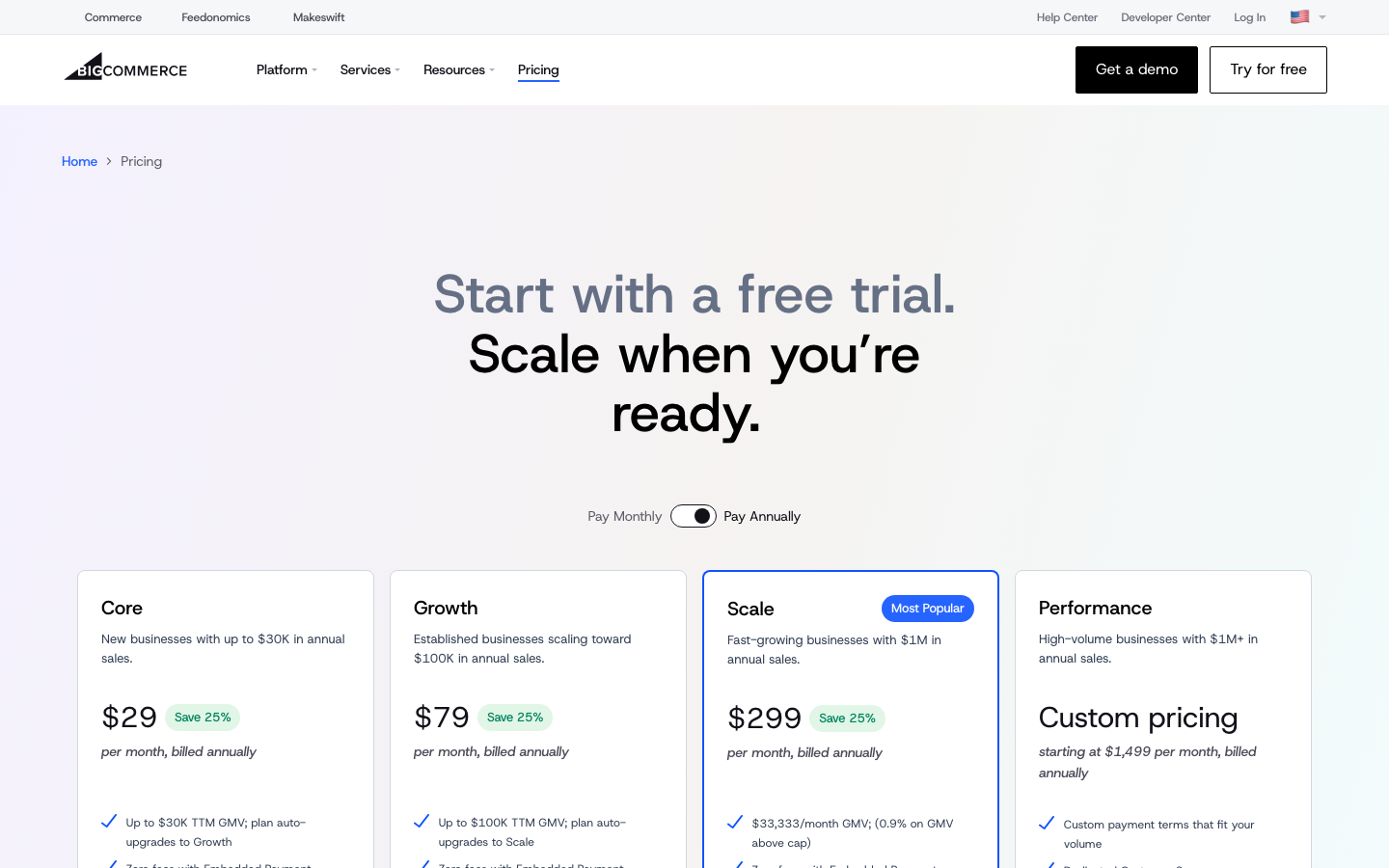
The base annual subscription for Core is $348, calculated as $29 times twelve months. Growth costs $948 for a year at the published annual-billing equivalent, while Scale costs $3,588. Those figures don't include taxes, card fees, apps and any eligible provider or overage charges. Performance is quoted individually, so its published starting point shouldn't be treated as a guaranteed proposal.
What changed in BigCommerce pricing in 2026?
BigCommerce pricing changed in 2026 through new plan names, updated GMV rules and fees for eligible orders processed through open payment providers. The current official page explains the Core, Growth, Scale and Performance framework and is the one merchants now see when they manage a plan under Account, Upgrade Plan. Older comparisons can misstate both sales thresholds and transaction costs.
The distinction matters because a merchant can easily compare the same advertised annual subscription with a materially different gateway bill. A store that's using an embedded payment provider is treated differently from one using an open provider. Sales growth also affects the tier, and it's the part buyers forget: Core and Growth have trailing-twelve-month GMV thresholds, while Scale applies an overage calculation. Finance shouldn't copy a previous year's plan assumptions into a renewal spreadsheet, since they're likely out of date.
What else can add to a BigCommerce bill?
BigCommerce lists several charges next to the plan price. Card processing for debit and credit cards begins at 2.89% plus $0.29 per transaction, subject to eligibility for the published rate, and the standard online American Express rate is 3.50% with no fixed fee. Those figures belong to the card-processing layer and they're separate from the open-provider platform fee described below.
Extra storefronts are priced as add-ons: $30 per month for up to 3 storefronts, $50 per month for up to 5 and $100 per month for up to 8. Confirm which plans can use them before budgeting a multi-storefront setup. The page also lists automatic upgrade to Performance once trailing-twelve-month GMV reaches $2 million.
When does BigCommerce automatically upgrade a plan?
BigCommerce automatically upgrades Core when the store exceeds its $30,000 trailing-twelve-month GMV threshold and Growth when it exceeds $100,000. Scale doesn't use the same simple tier jump; it works with a monthly GMV allowance and an overage calculation. The exact measure is BigCommerce's defined GMV, so merchants should reconcile it with their internal sales report.
BigCommerce says it calculates the relevant GMV from gross order value with a 10% reduction. That isn't necessarily the same number a finance team calls net revenue. The pricing page doesn't spell out every component of that figure, so a store close to a threshold should inspect its BigCommerce account figures rather than forecasting from an unrelated accounting report.
For planning, build a rolling twelve-month worksheet with a separate column for the platform's reported GMV. It's smart to add a warning well before the Core or Growth threshold. The aim is to see an upgrade coming rather than discover it on an invoice. A seasonal business should pay special attention to the months after a peak, when the trailing period can stay high even if current sales fall.
How do BigCommerce payment-provider fees work?
BigCommerce payment-provider fees depend on whether an order uses an embedded or open provider. The official US page lists no additional platform fee for embedded providers, while eligible open-provider GMV can incur 2.0% on Core, 1.0% on Growth or 0.6% on Scale. These fees are separate from the card processor's own charges, so they aren't a substitute for them.
| BigCommerce plan | Open provider fee (%) | Eligible GMV example (USD) | Platform fee example (USD) |
|---|---|---|---|
| BigCommerce Core | 2.0% | $1,000 | $20 |
| BigCommerce Growth | 1.0% | $1,000 | $10 |
| BigCommerce Scale | 0.6% | $1,000 | $6 |
The example assumes $1,000 of eligible order GMV processed through an open provider on each plan. It multiplies the published rate by that amount; it doesn't include processor fees or tax. A merchant who's using an embedded provider shouldn't apply the open-provider rate to those orders. Split the payment mix into provider types before modeling a year of costs; it's the step most worksheets skip.
What does a payment gateway quote need to show?
A BigCommerce payment gateway quote needs to show card processing rates, provider classification, payout terms, refund handling and any platform fee on eligible GMV. Ask whether alternative payment methods and international cards are priced differently, and get the answer in writing.
How much can Scale overage add?
BigCommerce Scale overage adds 0.9% of monthly GMV above $33,333, according to the current pricing page. The charge applies to the excess amount, not the entire month's GMV. A store that exceeds the allowance should calculate the overage separately from its subscription and payment processing.
For an illustrative month with $40,000 in BigCommerce-defined GMV, the excess is $6,667. Multiplying that by 0.009 gives about $60 before any rounding rules the vendor applies. The store still owes the base Scale subscription and any other applicable charges.
Does BigCommerce offer a free trial?
BigCommerce offers a fully functional 15-day free trial, and the pricing page says no credit card is required to start it. That makes the trial a cheap way to test checkout, catalog structure and the payment setup before committing to Core. It doesn't replace a cost model, though, because the trial can't show how provider fees behave at your real order volume.
Use the 15 days for the questions that change the bill. Decide whether orders will run through an embedded or an open payment provider, since that one choice decides whether the platform fee applies at all. Check which plan the store would sit on after launch, and don't skip it. Then put the numbers into a worksheet before the trial ends, so the first invoice doesn't set the budget by accident.
What does a yearly BigCommerce budget look like in practice?
A yearly BigCommerce budget stacks the subscription, the open-provider fee, any Scale overage and card processing, and each layer follows a different rule. Using only published rates, a store on Growth with annual billing pays $948 for the subscription. If $90,000 of eligible GMV runs through an open provider at the 1.0% Growth rate, the platform fee is $900. That's clearly a combined $1,848 before card processing, apps and tax.
Moving the same $90,000 through an embedded provider removes the $900 platform fee, because the pricing page lists $0 for embedded providers on all plans. The subscription stays at $948, and card processing is still charged separately. The example uses a round GMV figure for clarity; real stores shouldn't use it as a forecast and should substitute BigCommerce's own GMV report, which applies the 10% reduction before comparing against thresholds.
A smaller Core store shows the other side. At $20,000 of eligible open-provider GMV, the 2.0% fee is $400 on top of the $348 annual subscription, so the fee costs more than the plan itself. That's the case where checking the provider classification pays off first, and it's the easiest one to miss.
What is the annual cost of BigCommerce Core?
The annual cost of BigCommerce Core is $348 for the base subscription at the published $29 monthly equivalent with annual billing. Monthly billing would cost $468 over twelve months at $39 per month, assuming the plan doesn't change. Payment processing, eligible open-provider fees, apps and taxes sit outside both figures.
Illustrative base subscription only. Actual annual commitment is billed under vendor terms; excludes payment processing, apps, tax, GMV upgrades and gateway fees.
A cost worksheet needs a column for the subscription, one for payment processing, one for the BigCommerce open-provider fee and one for extensions or support.
Which BigCommerce plan should a merchant choose?
A merchant should choose BigCommerce Core for a new store below its published GMV threshold, Growth as the store nears $100,000 of trailing-twelve-month GMV and Scale when monthly volume approaches the $33,333 allowance. Performance starts at $1,499 per month billed annually, with the final price set by contract. The best choice also depends on what's in the payment contract and how quickly the store may cross a threshold.
- New store with limited GMVModel Core and the $30,000 TTM threshold.
- Store approaching Core thresholdModel Growth at $79 per month billed annually.
- Higher volume and monthly overage exposureModel Scale at $299 per month billed annually plus 0.9% excess GMV.
- Contracted high-volume requirementsRequest Performance terms and a written payment-provider classification.
A practical selection meeting should include ecommerce operations, finance and whoever owns payments. Operations tests catalog and checkout behavior, finance models GMV and provider fees and the payments owner verifies the gateway contract, so nobody's guessing. A cheaper plan that triggers an immediate upgrade can be more disruptive than choosing the correct tier at launch.
How does BigCommerce pricing compare with Shopify?
BigCommerce pricing and Shopify pricing can share a similar entry-level annual-billing amount, but their fee and upgrade models differ. BigCommerce Core lists $29 per month billed annually with a GMV threshold and open-provider rules. Shopify Basic also lists $29 per month billed annually, with its own processing and third-party transaction fee structure.
The useful comparison isn't just $29 versus $29. It's the annual cost at the merchant's projected GMV, payment mix and required apps. For BigCommerce, model the threshold and provider classification. For Shopify, model the chosen payments route and required extensions. Neither vendor's starting price describes the entire checkout bill, and that isn't a minor detail. For a wider category view, see best ecommerce platforms and Shopify pricing.
Where does feed quality fit into a BigCommerce budget?
Feed quality fits into the BigCommerce budget as a separate operational control when product data leaves the storefront for advertising or shopping channels. Product feeds can easily contain incorrect currency values, missing attributes or duplicate identifiers even when the website appears normal. Monitoring a feed isn't a substitute for correcting product data inside the store.
A merchant shouldn't leave feeds unowned, so assign ownership for feed exports and define a pre-publication check. If the business publishes public XML, CSV or TSV feeds, comparing successive versions can help expose unexpected changes before they affect campaigns. Budget feed monitoring as an operations cost, not as part of the platform subscription.
What should buyers know about BigCommerce pricing?
BigCommerce pricing questions usually concern free trials, automatic upgrades and whether the platform charges fees beyond the subscription. The official US pricing page gives answers, but it can't say how your store's orders are classified, so a merchant who's budgeting still needs to confirm the exact provider classification and contracted terms for its own store.
Does BigCommerce have a free plan?
BigCommerce doesn't list a permanent free subscription plan on its US pricing page. It offers a 15-day trial before a paid plan is required.
How much is BigCommerce Core per month?
BigCommerce Core costs $39 with monthly billing or $29 per month with annual billing, before payment processing and other fees.
Does BigCommerce charge transaction fees?
BigCommerce charges an additional platform fee on eligible GMV processed through open payment providers, with a rate that varies by plan. Embedded providers avoid that particular fee, though processor charges still apply.
What happens when BigCommerce sales exceed the Core limit?
BigCommerce automatically upgrades Core after its trailing-twelve-month GMV exceeds $30,000. Growth has a separate $100,000 threshold.
How much does BigCommerce Performance cost?
BigCommerce Performance has custom pricing that starts at $1,499 per month when billed annually. The actual quote depends on the contract.