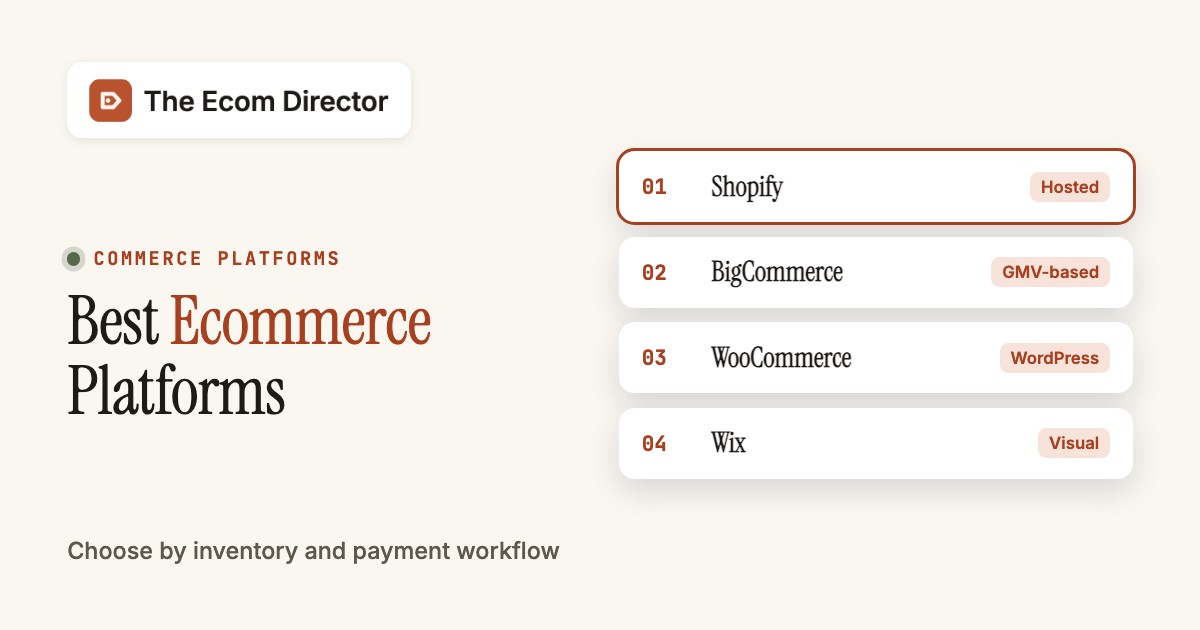
The best ecommerce platforms depend on what a store needs to operate, not on how quickly it can launch. Shopify fits hosted store operations, BigCommerce offers a GMV-aware alternative, WooCommerce gives WordPress teams control, Wix and Squarespace combine websites with selling, and Ecwid adds commerce to an existing site. Compare payment costs, inventory workflows and migration ownership before you choose, because they're where stores lose money.
A subscription price is just one part of the cost, and it's rarely the biggest. Store teams also have to budget for payment processing, apps, fulfillment connections, technical maintenance and the work that's required to keep product data consistent across channels.
Best ecommerce platforms by store workflow
The strongest choice depends on whether the business needs a hosted checkout, a flexible WordPress stack or a commerce layer for an existing website. Each option below solves a different operational problem, and they aren't interchangeable, so a single winner label would hide the trade-offs. There's no universal best here.
 Hosted store operationsShopifyCatalog, checkout and inventory in one hosted admin.
 GMV-aware commerceBigCommerceEvaluate plan thresholds and eligible payment-provider fees.
 WordPress controlWooCommerceFree core software with merchant-owned hosting and extensions.
 Visual site buildingWixA visual editor with ecommerce and variant inventory.
 Content-first storesSquarespaceIntegrated website and store with a Basic plan fee trade-off.
 Existing websitesEcwidEmbed a store without rebuilding the primary website.
Ecommerce platform comparison by price and responsibility
This comparison separates published annual subscription equivalents from the work of running a store. Prices are vendor snapshots checked October 25, 2026, not quotes for a particular merchant, and payment processing or other services may cost extra. You'll want to confirm the final number at checkout.
| Tool | Commerce model | Operational handoff | Published price | What it is |
|---|---|---|---|---|
| Shopify | Hosted ecommerce | Catalog to checkout and inventory | Basic $29/mo annually | Hosted commerce operations with location inventory and processor-dependent fees |
| BigCommerce | Hosted ecommerce | Catalog to storefront and payments | Core $29/mo annually | GMV-based plan thresholds and Open Payment Provider Fee |
| WooCommerce | WordPress ecommerce | WordPress products to checkout | Free core, hosting extra | Merchant controls hosting and extensions |
| Wix | Website builder | Visual editor to catalog and checkout | Core $29/mo annually | Site builder with variant inventory |
| Squarespace | Website builder | Content to store and checkout | Core $29/mo annually | Content-first commerce with Basic plan transaction fee |
| Ecwid | Embeddable ecommerce | Existing website to store | Venture $29/mo annually | Embedded store and Business-tier variation stock |
US vendor prices checked October 25, 2026. Shopify and Squarespace show prices by country, so figures here are US dollar rates.
The practical comparison starts with the source of truth for inventory, the payment provider and the staff who'll fix failed orders. A low plan fee won't save money if the business has to reconcile product or fulfillment data every day.
Shopify: a hosted platform for daily store operations
Shopify, a hosted ecommerce platform, combines product catalog, checkout and order operations in a single admin. Its US-targeted pricing shows Basic at $29 per month when billed yearly. Shopify shows different currencies and rates by country, so the amounts here are the US dollar prices.
Shopify supports inventory locations, quantity adjustments and transfers, which is what most multi-site sellers care about. They don't want spreadsheets. The official location guide lists 10 active locations for Basic, so teams with multiple stock sites should check which locations are physical and which they're representing through fulfillment apps.
Shopify
Hosted commerce operations with location inventory and processor-dependent fees
Best for a merchant that wants a hosted checkout and a central operating interface.
- you want hosted checkout, catalog and inventory in one admin
- you manage stock across several locations
- you need a payment provider outside Shopify Payments and the extra transaction fee matters
- you want full code ownership of the stack
How it works in practice
A store manager can update a product, adjust stock by location and process orders in the same administration area. The risk starts at the edges, and it's real: a fulfillment provider may update quantities late, a marketplace may need different attributes and an app can add a recurring charge you didn't plan for.
Choose Shopify when the team values a hosted operating system more than full code ownership. It isn't the right fit for everyone. Skip it when a specific external processor or unusual backend architecture makes the fees and integrations unattractive, which is common.
- Starting price
- Basic $29/mo annually
- Annual Basic equivalent
- $29/mo
- Inventory
- Location-based quantities and transfers
- Commercial caution
- External payment-provider fees
BigCommerce: plan thresholds matter as much as features
BigCommerce, a hosted ecommerce platform, changed its plan structure in 2026. Core costs $29 per month on annual billing, Growth costs $79 and Scale costs $299. The company also introduced an Open Payment Provider Fee on eligible self-serve transactions.
That policy changes the buyer calculation, and it's easy to miss. A team shouldn't budget from BigCommerce's old Standard or Plus plan table. It should forecast gross merchandise value and payment-provider mix instead. The business has to know what triggers a tier change and how it's defined in the fee terms.
BigCommerce
GMV-based plan thresholds and Open Payment Provider Fee
Best for operators willing to model sales-volume thresholds and provider costs.
- you can model sales volume against plan thresholds
- you want a hosted platform with a catalog-first setup
- you need a fixed, predictable bill regardless of payment provider mix
- you can't forecast eligible provider usage
How it works in practice
A finance owner should reconcile order value against the platform's inclusive GMV definition and identify transactions that qualify for its payment-provider fee. The commerce lead should map catalogs, channels and checkout requirements before a plan's approved.
Choose BigCommerce when the business can weigh these terms against its real order data. Skip it if a predictable flat bill is non-negotiable and the store can't forecast provider usage, because it won't get one.
- Starting price
- Core $29/mo annually
- Current plans
- Core, Growth, Scale
- Core annual equivalent
- $29/mo
- Fee issue
- Open Payment Provider Fee
WooCommerce: open-source flexibility with operational ownership
WooCommerce, the ecommerce plugin for WordPress, provides a free core platform with no monthly software subscription. Hosting, payment processing, extensions and technical maintenance remain separate responsibilities, and they aren't included in the free price.
WooCommerce documents stock management settings for quantities, unpaid orders and out-of-stock behavior. Those controls can work well for a content-led store, but someone still has to maintain hosting, backups, plugin compatibility and checkout performance.
WooCommerce
Merchant controls hosting and extensions
Best for a WordPress business with a capable technical owner.
- you already run WordPress with a reliable maintenance process
- you want control over hosting, plugins and checkout
- nobody owns backups, security updates and emergency fixes
- you want one vendor responsible for uptime
How it works in practice
The merchant can keep its WordPress content stack and add product records, categories and inventory controls. A store with custom plugins can shape the buying experience, while that same freedom creates more maintenance work when an extension update affects checkout.
Choose WooCommerce if the team's already got a reliable WordPress maintenance process. Skip it if nobody owns backups, security updates or emergency fixes. That's the usual failure.
- Starting price
- Free core, hosting extra
- Core software
- Free
- Hosting
- Purchased separately
- Inventory
- Configurable quantity and hold-stock settings
Wix: visual merchandising with inventory controls
Wix, a hosted website builder with ecommerce plans, isn't only a site tool. It's aimed at businesses that want to manage site design and selling together. Wix Core is shown at $29 per month on an annual subscription, and Business is $39 per month on an annual subscription.
Wix Stores supports quantity tracking for products and individual variants, so it's well suited to apparel. That matters when a store sells clothing or configurable products, since a single in-stock flag can't express what's available in each size and color.
Wix
Site builder with variant inventory
Best for a small team that edits product and marketing pages visually.
- you edit product and marketing pages visually
- you sell products with size or color variants on a small team
- you need complex backend order orchestration
- you need extensive custom commerce logic
How it works in practice
A merchandiser can publish a landing page, add products and choose whether inventory is tracked by quantity or availability status. The team should still define how SKUs match warehouse records and what happens when a return's received.
Choose Wix when visual site editing is clearly the priority. Skip it when complex backend orchestration or extensive custom commerce logic is the deciding requirement.
- Starting price
- Core $29/mo annually
- Core
- Basic ecommerce and payments
- Business
- Standard ecommerce
- Stock
- Product and variant inventory tracking
Squarespace: a website-first route to selling
Squarespace, a hosted website and commerce builder, suits brands that sell alongside content or services. It's a website first. Its Core plan is shown at $29 per month with annual billing. The cheaper Basic plan lists a 2% online store transaction fee, so the least expensive subscription isn't always the least expensive store. That's easy to overlook.
The key decision's whether a content-first business expects enough online sales for the fee difference to matter. Compare platform transaction charges with payment processing and the features the store will need after launch, since they'll differ by plan.
Squarespace
Content-first commerce with Basic plan transaction fee
Best for design-led sites with a straightforward product catalog.
- you sell alongside content or services on a design-led site
- your product catalog is straightforward
- you rely on complex fulfillment or wholesale catalogs
- you expect to stay on the Basic plan with high sales volume, where the 2% fee adds up
How it works in practice
A small brand can maintain editorial pages and product listings in the same site editor. Before choosing Basic, the owner should model transaction fees on the expected order mix and compare what they'd pay with Core.
Choose Squarespace if you want integrated site and store publishing. Skip it when complex fulfillment, wholesale catalogs or custom backend operations are essential.
- Starting price
- Core $29/mo annually
- Core annual equivalent
- $29/mo
- Basic online-store transaction fee
- 2%
- Fee model
- Processing is separate
Ecwid: selling through a site that already exists
Ecwid, an embeddable ecommerce platform, is designed for businesses that want to add a store to an existing website. Venture costs $29 per month with annual billing and Business costs $49 per month with annual billing under its updated 2026 USD plan schedule.
Ecwid's documentation says variant-level stock tracking is available on Business and Unlimited, so it isn't on the entry plan. A merchant selling apparel should verify that requirement before selecting Venture, because an entry-tier saving can disappear if SKU-level inventory requires an upgrade.
Ecwid
Embedded store and Business-tier variation stock
Best for adding a commerce layer without replacing the main website.
- you want to add a store to a site you already have
- you want to keep your current website
- you need a fully custom checkout
- you need variant-level stock but plan to stay on Venture
How it works in practice
A business can keep its current site and manage products through Ecwid. When colors or sizes need separate stock, each variation needs its own SKU and quantity, otherwise it'll show incorrect availability.
Choose Ecwid if you want an embedded storefront. Skip it when the business needs a fully custom checkout or the chosen plan doesn't support the required stock controls.
- Starting price
- Venture $29/mo annually
- Venture annual equivalent
- $29/mo
- Business annual equivalent
- $49/mo
- Variant inventory
- Business and Unlimited
How to choose an ecommerce platform for real operations
Your selection process shouldn't begin with a demo. It should begin with catalog ownership, checkout reconciliation, fulfillment and customer exceptions. A platform that looks polished in a demo can still leave very costly gaps between inventory systems, payment reports and support workflows.
- CatalogProduct data
- Shopify
- BigCommerce
- WooCommerce
Breaks when Assign an owner to each SKU and feed. - CheckoutPayment capture
- Shopify
- Squarespace
Breaks when Model provider fees and refunds. - FulfillmentStock and shipping
- Wix
- Ecwid
Breaks when Test variant inventory and order exceptions. - SupportReturns and disputes
- WooCommerce
- BigCommerce
Breaks when Reconcile refunds with the order ledger.
A store owner shouldn't rely on memory. They should record which system can change a product price, how long stock updates take and who's alerted when orders fail. The answers matter far more than any headline conversion benchmark.
Ecommerce platform migration checklist
An ecommerce migration needs a tested path for products, redirects, orders and inventory. Launching the new design without reconciling these records creates real, preventable operational risk.
- Export products, variants, SKUs and product images before you touch either platform.
- Identify the stock source of truth and freeze or reconcile updates during cutover, since two live sources won't agree.
- Map old URLs to new URLs and test redirects on the pages that matter, because they're what search traffic lands on.
- Test the US payment, shipping and tax combinations you'll actually use with representative orders.
- Verify refunds, partial fulfillment and canceled orders before they're needed.
- Reconcile the first payment settlements with the order ledger, since that's where gaps show up.
- Assign an owner to each integration and document the conditions that'd trigger a rollback.
Payment fees and total cost of ownership
Total ecommerce platform cost combines the subscription, payment processing, transaction-linked charges, apps, hosting where applicable and operating labor. Shopify charges third-party transaction fees when a store uses an external provider, and it's worth checking the current rate. BigCommerce now has its own eligible provider fee, while WooCommerce leaves hosting and extensions to the merchant, so there's no single fee model to copy across.
Model the same order volume and payment mix across the platforms, because you can't compare plans otherwise. The cheapest plan might win for a new store, but that result can change once returns, apps and manual inventory corrections are included.
Where product feed monitoring fits
A storefront holds product records, but a feed that's sent to shopping channels can still contain missing attributes, duplicate IDs or unexpected price changes. Feed monitoring is a separate control, and it isn't a replacement for a commerce platform.
The Ecom Director checks small public XML, CSV and TSV feeds and monitors changes, but it doesn't rewrite or distribute product feeds. That narrower role can help a store operator notice data drift after choosing a platform.
Ecommerce platform FAQ
Most buyers just want to know who maintains the store, what costs sit outside the plan and whether an existing website can add commerce without a rebuild.
What is the best ecommerce platform for a small business?
The best ecommerce platform for a small business depends on catalog complexity and technical ownership. Shopify and Wix fit hosted operations, while WooCommerce suits a team already maintaining WordPress.
Is WooCommerce free?
WooCommerce core is free, but hosting, payment processing and paid extensions can still cost money, so it isn't free to run. The merchant also owns technical maintenance.
Do ecommerce platforms charge transaction fees?
Yes, some ecommerce platforms charge transaction fees under specific plans or payment-provider conditions. Compare those charges separately from card processing, because they aren't the same fee.
Can I add an online store to an existing website?
An existing website can add commerce through an embeddable option such as Ecwid. Confirm the plan supports the product variants and inventory workflow you'll need.
Which ecommerce platform is best for multiple inventory locations?
The best platform for multiple inventory locations is the one that matches the store's fulfillment and stock reconciliation process. Shopify documents location-based inventory, but external warehouse updates still need monitoring, and that's true on every platform.